Medical gas installation and medical gas centralization in hospitals
Did you know, FRES friends, that medical gas installation is one of the most important needs in hospitals? Why? Because medical gas is one of the most needed when a patient is in an emergency or in a coma. Therefore, the need for air is large and can be used at any time.
MEDICAL GAS INSTALLATION STANDARDS
- Professional installersMedical gas installation work must not be done haphazardly, as it involves the lives of many people. However, it must be carried out by professional personnel, as it is required to be safe and maintain quality standards.
- Oxygen Center Similarly, oxygen centers can be manual, semi-automatic, or fully automatic, equipped with liquid oxygen tanks. Both centers must meet medical standards. They cannot simply be ordinary centers operating without reference to medical standards.
- Medical Gas Pipes Medical gas installation pipes must comply with applicable standards and must be made of copper with standards recognized both in Indonesia and internationally. When installing medical gas, the pipes used must be completely clean and free from contamination.
- Zone Valves and Alarms Zone Valves function to protect a medical gas installation's operational area from various preventive measures in the event of damage in one of the areas. The alarm functions to indicate pressure in a specific area and provides a signal if gas pressure decreases or becomes excessive in a specific area.
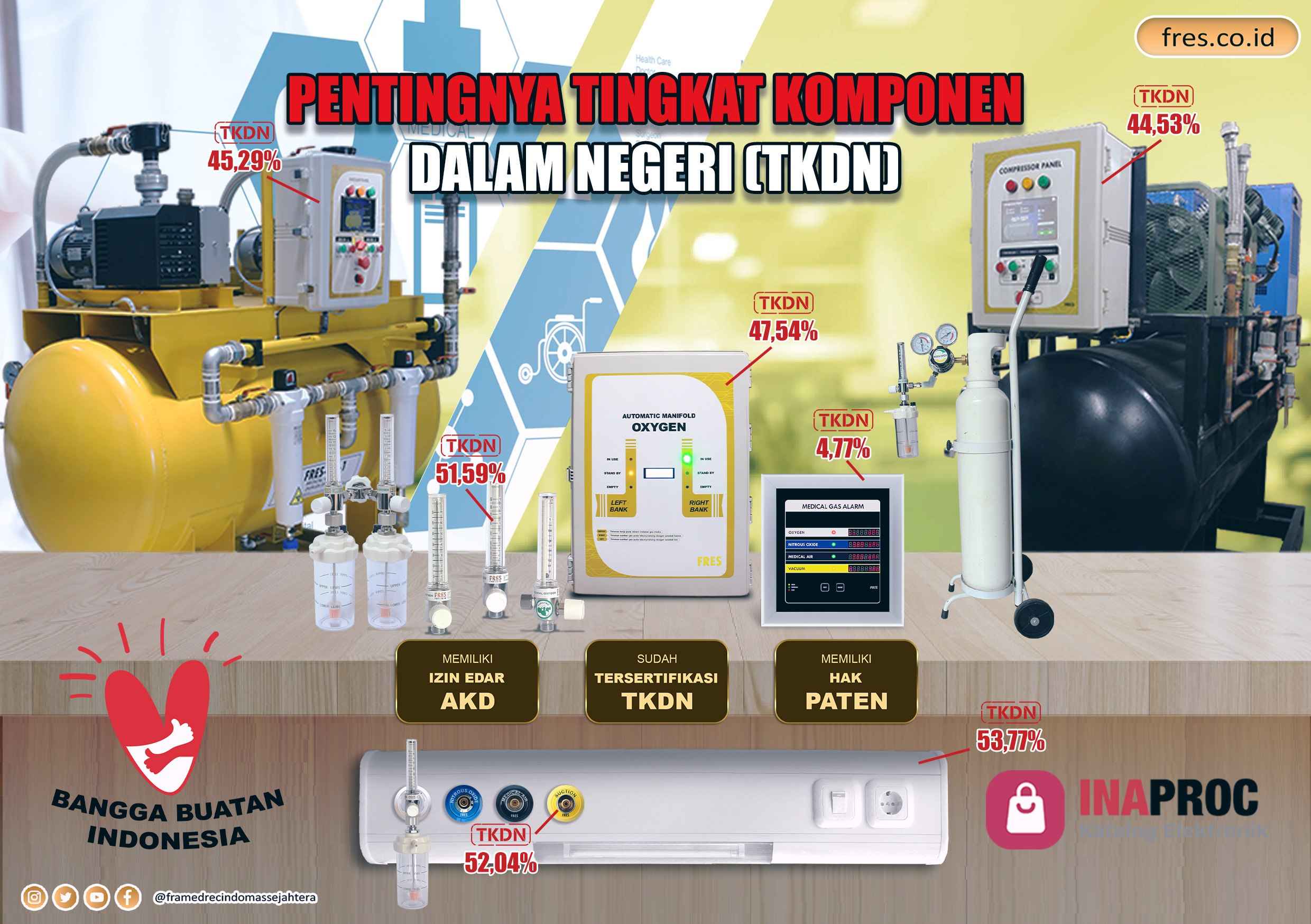
Central Compressor
For equipment in the anesthesia system and ICU/NICU/PICU (ventilators), compressed air with a pressure of 4 bar (60 psi) is required. Furthermore, compressed air can also be used for orthopedic purposes. Therefore, its perfect function in the medical field makes it commonplace to meet the medical gas needs of every hospital.
Central Vacuum
A central vacuum/suction/air suction system provides consistently available suction air from a central vacuum/suction/air suction source that is integrated into one unit and can produce stable and pure suction air for medical needs. The vital role of suction air in the medical world has been highlighted recently. To support hospital operations, portable vacuum/suction systems have begun to be discontinued. They have been replaced by centralized systems similar to medical gas installation systems.
Piping
Medical gas installation connections must use silver welding with a mixture of oxygen and acetylene. During welding, nitrogen gas must be supplied through the pipe. Medical gas piping connections must use appropriate fittings such as elbows, tees, reducers, and socks. To distinguish between gas types, stickers must be installed on the pipe installation, indicating the type and direction of flow, with sufficient spacing (±2 meters). Piping installations attached to walls or partitions must be equipped with protective conduit/PVC.
During welding, the pipe must be supplied with nitrogen gas to remove any weld deposits that may form inside the pipe. The entire piping system for each type of gas must be equipped with a main valve installed in the central room. Zone valves are installed according to the installation's distribution.
Digital Alarm
A digital alarm system is a unit that functions as an information tool that indicates the volume of medical gas in a medical gas installation work area. Alarm systems are typically placed at nurse stations to facilitate monitoring and ensure that medical gas remains safe for patients to use at all times.
Box Valve/Zone Valve
A box valve/zone valve is a device used to regulate the flow of medical gas by closing, opening, or restricting it. Box valves/zone valves not only regulate the flow of medical gas but also serve to protect a medical gas installation's operational area from various preventive measures in the event of damage in one of the areas. Box valves/zone valves are also used to control or prevent the spread of fire within a specific area of the hospital. For example, if a fire occurs in the oxygen room, the valve box/divider must be immediately turned off to prevent another explosion in one of the operational areas of the medical gas installation.
MANUAL CENTRAL SYSTEM
Manual Gas Manifold provides a constant gas supply from all cylinders in the central system, both on the right and left sides. It is ideal for hospitals with oxygen usage below 100 cylinders per month. It is highly efficient and safe to operate. The pressure gauge clearly displays the gas source and the total pressure distributed to the pipes and outlets. It has a safety valve that automatically opens if the pressure becomes too high. 100% pressure test pass rate. Available for O2, Air, N2O, N2, CO2, and Liquid Oxygen.
AUTOMATIC CHANGE OVER MANIFOLD CENTRAL SYSTEM
Mahakarya Indonesia is here to complement the needs of medical gas and vacuum installation systems in Indonesia.
The Digital Automatic Manifold system is built to high standards and quality and functions automatically to transfer empty pressure from used oxygen, nitrous oxide, carbon dioxide, nitrogen, and other cylinders to full cylinders (standby) to ensure the continuous flow of medical gases without having to wait for manual replacement by experts.
This manifold has a local signal and/or indicator that can indicate the status of the manifold if the pressure in the first (primary) or second (secondary) header is lower than the required pressure. It has been indicated (empty bottle). It can visually indicate when one of the gas sources is depleted. It also has a digital indicator and can be connected and monitored with a computer monitor system (as an optional system).
It has an output pressure of 4-7 bar and can flow up to 350 m3/h (5800 LPM), capable of serving more than 1,000 beds, a first in Indonesia and for Indonesia.
100% pressure test pass; Available for O2 (oxygen), Compressed Air (compressed air), N2O (nitrous oxide), N2 (nitrogen), CO2 (carbon dioxide), LO2 (Liquid Oxygen/Portable bottled oxygen); Power input 240 VAC, 50 Hz.
Greetings FRES, Greetings Medical Gas Installation