When creating COVID-19 wards, oxygen levels in the central storage tanks were often sufficient. However, in inpatient (RANAP) or COVID-ICU wards, the oxygen pressure was extremely low, or oxygen outlets were completely non-functional. Why does this happen? Can purchasing through the E-Catalog solve this problem?
It is necessary to examine the source (central oxygen), the piping prior to room conversion, and the status after the conversion to COVID-19 treatment or ICU wards. Information is needed regarding the supply capacity of the manifold in the central oxygen room and the volume capacity flowing through the copper medical gas pipes. According to WHO data, the majority of COVID-19 patients exhibit these symptoms:
- 40% mild symptoms: use 1-2 LPM (children) & 5 LPM (adults) [Normal usage <3 LPM – Normal Design (non-COVID) 15 LPM]
- 40% moderate symptoms: use 5 LPM [Normal Design (non-COVID) 15 LPM]
- 15% severe symptoms: use 10-15 LPM [Normal Design (non-COVID) 15-20 LPM]
- 5% critical condition: use 15-70 LPM [Normal Design (non-COVID) 40 LPM], requiring Intensive Care Unit (ICU) treatment with HFNC and NIV.
Were the room outlets designed using these methods before becoming COVID wards? If not, the pipes and the central oxygen manifold must be replaced. While the design values for severe patients match, the design for 5% of critical cases is far below actual needs. This occurs in almost all hospitals in Indonesia, leading to oxygen supply failure.
Both the piping and the central oxygen system are critical to maintaining pressure and capacity. This situation mirrors the 2003-2004 bird flu outbreak, where hospitals ran out of oxygen not due to supply shortages, but due to poor piping design.
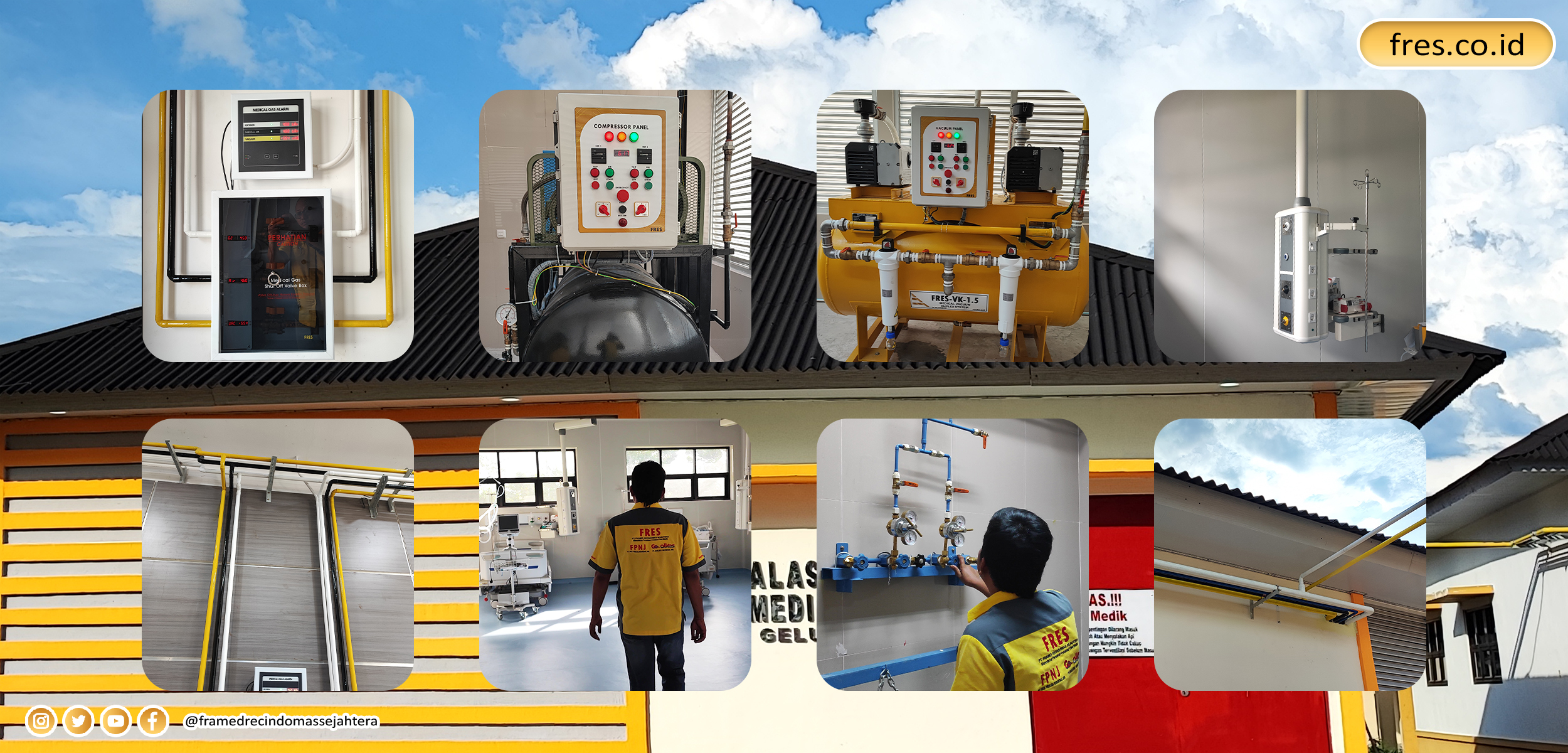
Why does this happen? It is caused by pipe designs that fail to balance pressure and flow capacity requirements.
Furthermore, medical gas installations are often only subjected to pressure tests upon completion. If there are no leaks, the system passes. However, there is a 'pressure drop test' that measures flow and pressure continuity. Because many installers and testing institutions in Indonesia lack this equipment, pressure loss is only discovered when oxygen is used simultaneously at maximum capacity.
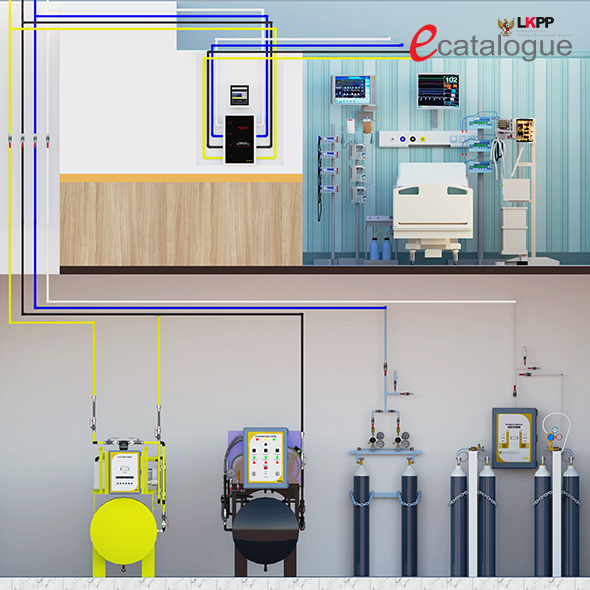
By purchasing through the E-Catalog, we calculate the piping system in detail—both existing and planned—to prioritize patient safety. With the inclusion of medical gas and vacuum systems in the National E-Catalog, we hope for improved quality. We do not limit pipe dimensions during planning, as this contradicts pressure drop testing. When adding outlets, flow capacity must increase; the capacity of existing pipes must be recalculated.
Why has the procurement shifted from building construction tenders to the E-Catalog?
Since the Ministry of Health classified medical gas and vacuum equipment as medical devices requiring distribution permits, they can now be sold via the E-Catalog. This ensures product quality. We ensure oxygen, anesthesia gas, medical compressed air, and medical vacuum supplies are well-distributed, avoiding failures like sudden pressure drops. We design piping using mechanical calculations to prevent pressure drops during high demand, as seen during the bird flu and COVID-19 crises, where equipment like HFNCs and ventilators failed due to low pressure (below 4 bar/60 psi).
By purchasing through the E-Catalog, especially FRES brand medical gas and vacuum products, we hope these incidents will not recur. Hospitals can feel secure, and asset recording becomes clearer. Mixing budgets with building construction makes asset tracking difficult, as construction and medical devices have different expenditure codes.
Many hospitals have not separated construction budgets from medical gas installation budgets. Medical gas and vacuum installations are no longer under the same KBLI (Standard Industrial Classification) as construction. Construction uses KBLI 41015, while medical gas and vacuum installations use KBLI 33200. This is because many still view these installations as simple piping rather than medical devices.
We hope the Procurement Service Unit (ULP) will help inform hospitals that the KBLI code for medical gas and vacuum installation is 33200, not construction. If a budget is already locked into construction and the DPA is insufficient for E-Catalog purchases due to specification differences, we request that additional budget (ABT) be provided so hospitals can purchase via the E-Catalog, especially domestic products (PDN) that ensure patient safety.
Thank you.