Is it true that medical gas systems are now available in the e-catalog? If so, why is the price so different from what it was before they were listed in the e-catalog?
We review the medical gas installation products available in the e-catalog, covering the products themselves, what customers receive, and the reasonableness of the prices for medical gas installations purchased through the catalog. By purchasing medical gas and vacuum installation systems, customers will receive a medical gas or vacuum manifold corresponding to the type of gas being purchased, provided there is a minimum purchase of 10 outlets for each gas type to qualify for the medical gas and vacuum central units. For example, purchasing 10 oxygen outlets, 20 vacuum outlets, and 10 medical compressed air outlets will result in the package directly including the medical gas and vacuum central units. The package mentioned above includes all items or components required for the installation of medical gas and medical vacuum systems.
The items or components in question include medical gas distribution systems, copper piping from the medical gas source to the gas or vacuum outlets or inlets, zone valves, zone and local alarms, medical gas and vacuum outlets or inlets (terminal outlets), and bedhead (wall duct) units made of aluminum and designed specifically for medical rooms in hospitals or community health centers. Also included is the installation of the acquired equipment, along with testing and certification of the purchased products. We also handle the PLANNING and DRAWINGS for the installation as a provider in the e-catalog. The planning we perform here differs from that conducted through hospital facility maintenance or tender systems. Let’s take a closer look at the details below.
The medical gas and medical vacuum installation products we have are the same as the products we previously tendered when installing them in hospitals. So what distinguishes the products featured in this e-catalog?
The medical gas and medical vacuum installation products currently listed in the LKPP E-catalog consist of components that are classified as medical devices (ALKES), for which marketing authorizations are issued directly by the Ministry of Health of the Republic of Indonesia. As a result, these products are guaranteed to be equipment that consistently prioritizes patient safety. Consequently, manufacturers and distributors of medical gas and vacuum installation equipment can have their services and distribution, as well as their locations and after-sales service capabilities, consistently monitored.
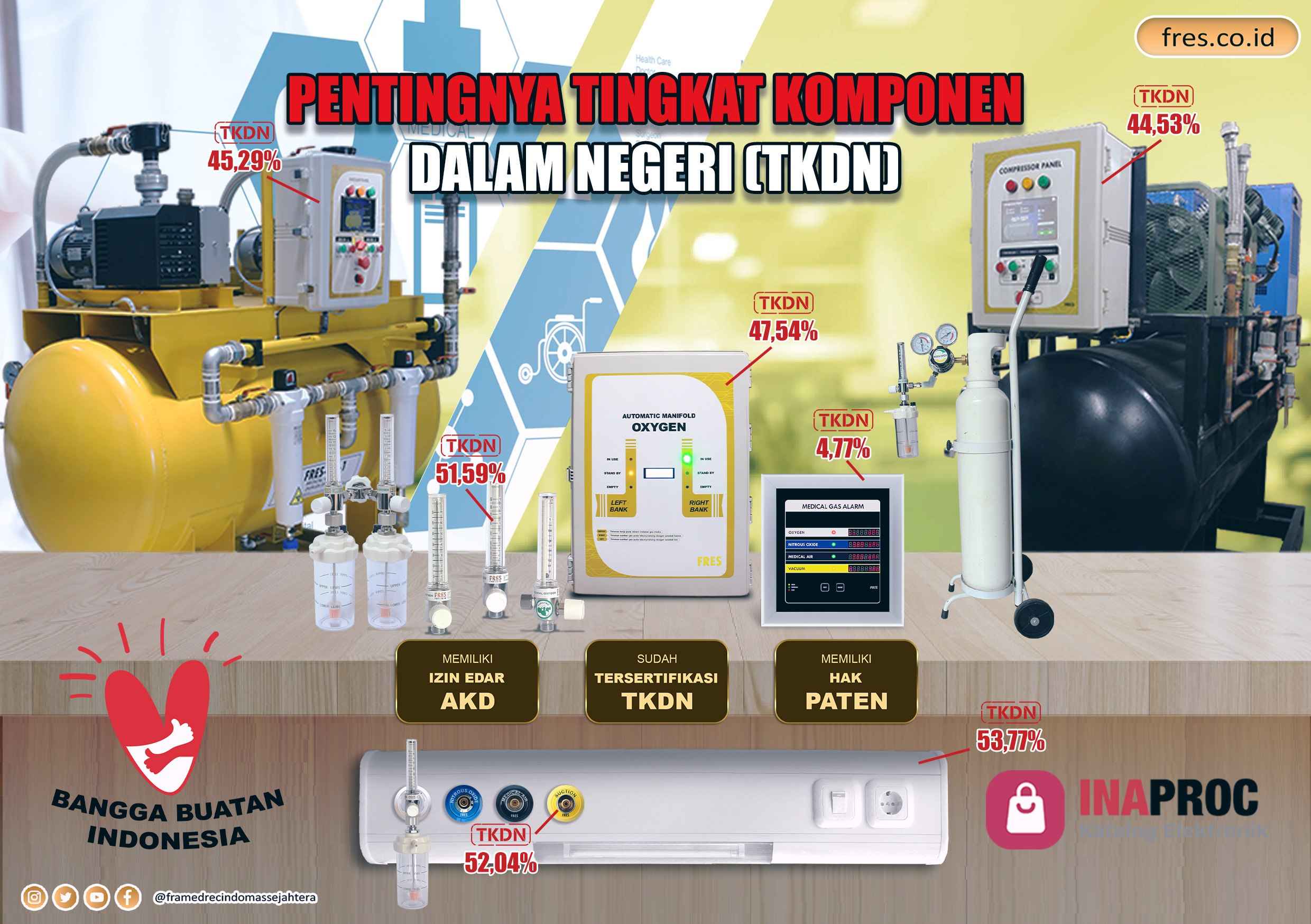
In addition, key medical gas and vacuum system equipment products are now being produced domestically. One such product, the FRES-branded medical gas and vacuum system, is the first of its kind in Indonesia to be manufactured and hold a trademark recognized by the Ministry of Law and Human Rights of the Republic of Indonesia. It also holds the first domestic product distribution license in Indonesia issued by the Ministry of Health of the Republic of Indonesia for its production. Therefore, it is recommended to purchase domestically produced medical gas system products.
The products are the same as those we previously tendered when installing them in hospitals. Why are the products in this e-catalog more expensive even though they are domestically produced?
Patient safety is the top priority, thanks to equipment that has been certified for medical use, including medical gas and vacuum systems, and the guaranteed availability of spare parts is a key feature of these medical gas and vacuum installations. In the past, when tenders were common, newly installed medical gas and vacuum systems in hospital buildings were directly included in the construction and civil engineering packages. If additions were to be made, they would be included in the building infrastructure maintenance budget or even incorporated into the procurement of MEDICAL OXYGEN or OTHER MEDICAL GASES. Currently, a popular approach is procurement through a KSO (Operational Cooperation) arrangement between the installation of medical gas systems and the procurement of OXYGEN, whether in gaseous or liquid form, within the hospital. Under a KSO, the hospital is provided with medical gas and medical vacuum systems free of charge, with no payment required for either the installation or procurement. Where are the payment costs allocated? These costs are included in the hospital’s monthly (or periodic) oxygen usage fees. Such procurement arrangements often result in significantly inflated costs when hospitals pay for oxygen through the KSO system.
The differences in procurement between TENDER and EKTALOG are most evident in the equipment and components used in medical gas and medical vacuum systems. These components or equipment include medical gas and medical vacuum systems: Medical Gas Manifold Stations (Oxygen; N2O; CO2; N2; Medical Compressed Air) – Medical Compressor Stations (Medical Compressed Air) – Medical Vacuum Stations. Also included are medical devices such as Medical Gas and Vacuum Alarms, as well as equipment directly related to medical gas and vacuum systems, such as: Oxygen Flowmeters (Wall-mounted, connected to terminal units/outlets) – Suction Regulators or Vacuum Regulators (Wall-mounted, connected to terminal units/inlets).
A notable difference between direct procurement and tenders compared to e-catalogs lies in the piping system. In direct procurement and tenders, the size or dimensions of the pipes are usually determined by the planner or even the prospective supplier participating in the direct procurement or tender for medical gas and medical vacuum installations at a hospital. Consequently, the next step is to identify the tender participant offering the lowest price that meets the specified requirements and the pre-determined budget plan. This differs from procurement via the e-catalog, where we, as the provider in this case, PT. Framed Recindomas Sejahtera, under the FRES brand, will be re-evaluating hospital requirements, with the most challenging aspect being the PLUMBING SYSTEM (MEDICAL-GRADE COPPER PIPING).
Requirements are calculated based on designs that comply with applicable medical gas and vacuum installation standards. Consequently, when planning is based on standards—whether Australian, HTM, ISO/SNI, or others—the resulting pipe dimensions or sizes are often extremely large. A common scenario we encounter during planning is that the smaller the total pipe length combined with a large number of outlet terminals, the larger the pipe dimensions required. Conversely, if there are many outlet terminals but the total pipe length is also substantial, the pipe dimensions do not need to be excessively large.
For example, installing 200 oxygen outlet terminals with a pipe length of approximately 2,500 meters requires a minimum pipe diameter from the oxygen central unit of (Actual) 3/8 inch (9.52 mm) to 3 1/8 inches (79.38 mm), where ideally, pipes with diameters ranging from 3/8 inch (9.52 mm) to 4 1/8 inches (104.78 mm) should be used. From this example, we can see just how far the current pipe dimensions installed in hospitals or healthcare facilities fall short of these requirements. This is indeed still difficult to test in Indonesia, both by the AHLI testing team and other testing teams, due to the lack of testing equipment for PRESSURE vs. VOLUME that meets medical gas and vacuum installation standards. In Indonesia, several hospitals or healthcare facilities—whether those with bed capacities of 50–100 beds (D), 100–200 beds (C), 200–250 beds (D), > 250TT (A), still use piping with diameters ranging from 3/8 inch to 1 1/8 inch; or, if the cost is slightly higher, they install 3/8 inch (9.52 mm) to 1 5/8 inch (41.28 mm) or slightly larger sizes such as 2 1/8 inch (53.98 mm), though this is rare.
The factors mentioned above result in a very significant price difference. Therefore, begin procurement and installation through a procurement company or installer that truly understands planning standards, particularly those for piping systems. Incorrect calculations or design will result in the hospital or healthcare facility failing to ensure patient safety.
CONTINUE TO PART 2