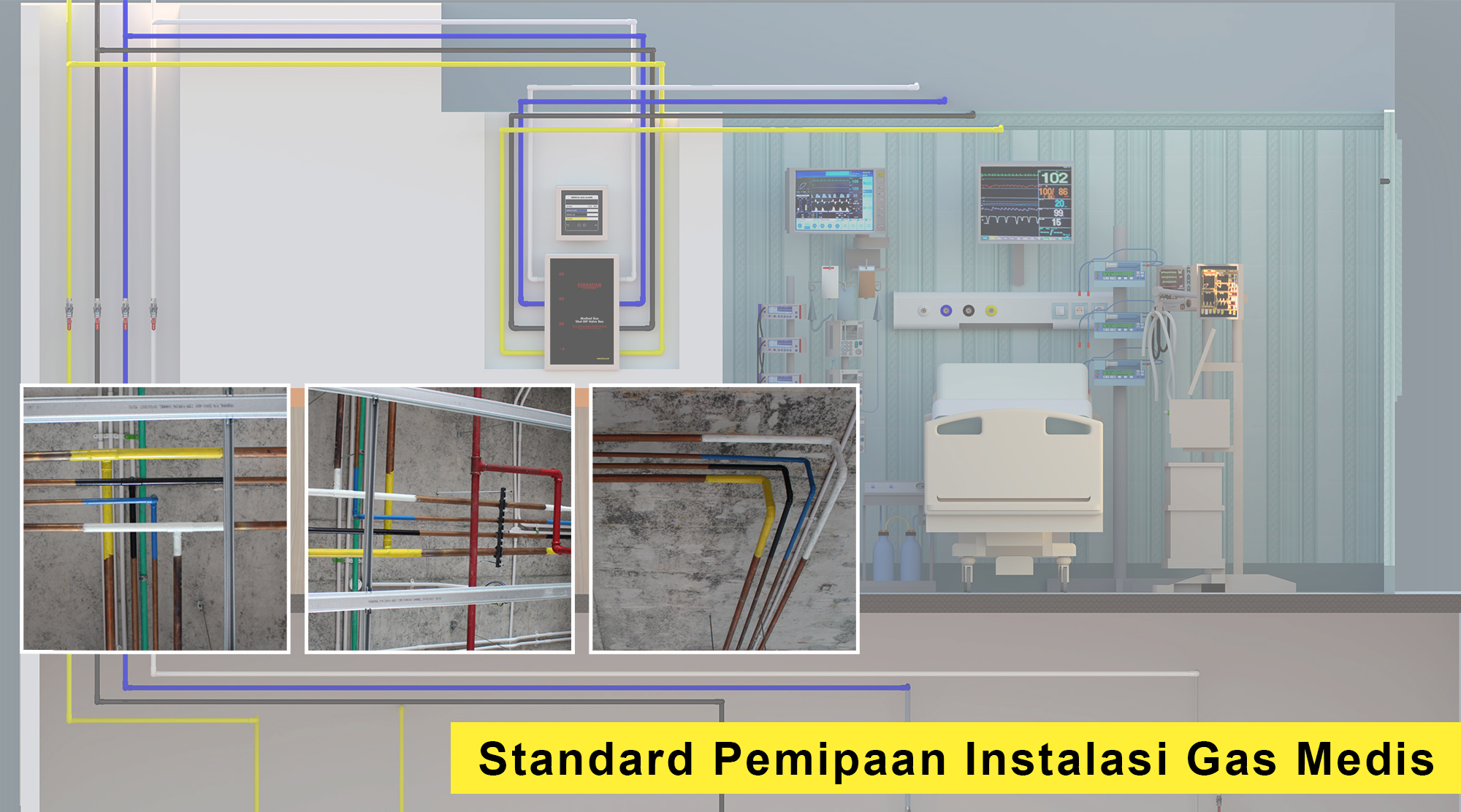
Standard Medical Gas Piping Installations (Copper) with a copper content above 99%. When constructing a medical gas piping system, the pipes must be made of copper with a copper content above 99% and accompanied by an international certificate of material authenticity.
Medical gas piping installations must be connected using silver welding with an oxygen-acetylene mixture. Nitrogen gas must be flowed through the pipe during welding. Medical gas piping connections must use appropriate fittings such as elbows, tees, reducers, and sockets. To distinguish between gas types, stickers must be installed on the pipe installation, indicating the type and direction of flow, with sufficient spacing (±2 meters). Piping installations attached to walls or partitions must be equipped with protective conduit/PVC.
During welding, the pipe must be flowed with nitrogen gas to remove any weld deposits that may form inside the pipe. The entire piping network for each type of gas must be equipped with a main valve installed in the central room; zone valves are installed according to the installation division.
Quodte
TECHNICAL GUIDELINES FOR HOSPITAL INFRASTRUCTURE, MEDICAL SYSTEMS AND MEDICAL VACUUM
DIRECTORATE OF MEDICAL SUPPORT SERVICES AND HEALTH FACILITIES DEVELOPMENT, DIRECTORATE OF HEALTH EFFORTS DEVELOPMENT, MINISTRY OF HEALTH, 2012
Pipe 1
Pipe material for positive-pressure medical gas installations installed on-site.
- Pipes, valves, fittings, outlet stations, and All other piping components in the medical gas system must be cleaned for oxygen service by the manufacturer prior to installation in accordance with applicable regulations, except that fittings may be cleaned by a supplier or agent other than the manufacturer.
-
Each length of pipe must be shipped with its ends capped or plugged by the manufacturer and remain sealed until ready for installation.
-
Fittings, valves, and other components must be shipped sealed, labeled, and remain sealed until ready for installation.
-
Pipe must be Type L or equivalent, hard-drawn seamless copper, except that where the working pressure is above 1275 kPa (185 psig), Type K or equivalent must be used for sizes larger than DN 80 (NPS 3) (3 inch outside diameter).
-
Medical gas pipe meeting applicable requirements must be identified or certified by the manufacturer with a marking. OXY, MED, OXY/MED, OXY/ARC, or ACR/MED in blue (type L) or green (type K)
- The installer must submit official documentation stating that all installed pipe materials meet the requirements of p>
- Pipe materials for medical-surgical vacuum systems installed on-site
- Vacuum piping must be copper, either ASTM B 819/BSEN 13348 medical gas piping, ASTM B 88 water cube piping (types K, L, M), or ASTM B 280 ACR piping.
a